
Balthasar “Bobby” Woll was born on 1st September 1922 in the small town of Wemmetsweiler, near Neunkirchen in the Saarland. Just ten years old when the Nazis came to power, the young Saarlander successfully qualified as an apprentice electrical engineer, before joining the Waffen-SS in August 1941, just short of his twentieth birthday.
Woll’s first assignment was with the 3rd SS Division Totenkopf, where he was trained as a machine gunner, specialising both the MG 34 and MG 42, with the 3rd Company of the 1st Infantry Regiment. Thrust straight into the fires of the Eastern Front, the twenty year-old immediately found himself right in the thick of the action, where Totenkopf were involved in the bloody rearguard at the Demyansk pocket in early 1942.
In what was a bitter struggle, the division was whittled down to a fraction of its initial size, with close to eighty percent of its personnel being killed, wounded or missing in action. Woll was one of the lucky ones, but didn’t escape unscathed. Wounded in action, he was transferred back to France for hospital treatment. Like many who were at Demyansk, Woll served with distinction. He was awarded the Iron Cross Second Class on 23rd July 1942, and the wound badge in black three days later.
Assignment to the Leibstandarte
After recovering from his wounds, Woll would not return to the Totenkopf. Speaking in a rare interview in 1996, his experience at Demyansk had left a mark, and he was far from keen in pursuing a career in the infantry. The opportunity arose to join the Panzer arm, and after initially being transferred the assault artillery he was able to volunteer for gunner training at the Schießschule der Panzertruppen in Putlos, near Oldenburg. Thanks to an instructor who had taken a keen interest in him, Woll managed to find a path into the élite Leibstandarte Adolf Hitler.
Having been assigned to the Tiger company of the Leibstandarte in late 1942, Woll received specialist training in the use of the 88mm cannon. In early 1943 he joined the newly-formed 13th (Heavy) Tank Company, where he was teamed up with the then SS-Untersturmführer Michael Wittmann. It would the start of a highly successful collaboration, one where both men would bring the best out of each other.
During the course of 1943 and early 1944, Woll had established himself as one of the most accomplished gunners in the division, earning the Iron Cross First Class on 16th September 1943 after the conclusion of Operation “Zitadelle”. This was quickly followed by his promotion to SS-Rottenführer on 9th November.
Award of the Knight’s Cross
By early 1944, Wittmann and Woll were the poster boys of the division. Their success saw Wittmann being nominated for the Knight’s cross on 10th January, with Woll’s nomination coming just the following day. Both men were presented with their awards on 14th January. At that time, Woll had accounted for a staggering 80 enemy tanks and 107 anti-tank guns; he was the first and only NCO gunner to receive the prestigious award.
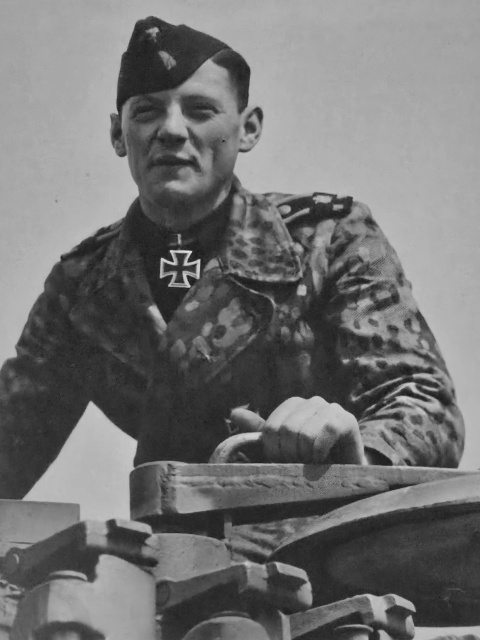
On 30th January, the same day as Michael Wittmann was awarded the Oakleaves to his Knight’s Cross, Bobby Woll was promoted to SS-Unterscharführer.
Wittmann and Woll were not only long-time colleagues, but solid friends as well; a friendship sealed in the heat of battle. At the Tiger commander’s wedding on 1st March 1944, his redoubtable comrade and gunner was his best man.
Reformation, and Villers-Bocage
The reformation of the 13th (Heavy) Company would see extensive changes, essentially ending the partnership that had excelled on the Eastern Front. Almost doubling in size, the newly-designated 101st (Heavy) SS Panzer Battalion saw Wittmann assume command of the new 2nd Company, with Woll assigned his own mount in the first of the three platoons. According to the Order of Battle this was turret number 212, but Woll would recall his being assigned to a new Tiger 335, an addition to the third platoon of the third company, commanded by SS-Obersturmführer Hanno Raasch.
The chaos in the wake of the Allied landings in Normandy saw the new Leibstandarte battalion thrust into the firing line, and with numerous Tigers breaking down on the way the scene was set for what would be the defining moment in the career of Michael Wittmann – and, if various accounts are believed, Bobby Woll. No evidence exists either way to prove that Woll was Wittmann’s gunner on 13th June 1944, but the game of musical chairs involving both vehicles and crews suggests that Woll was indeed with Wittmann on that day.
Wittmann’s command vehicle 205 had broken down, as had Woll’s designated mount. There is no official record of Wittmann’s gunner as he set off on his own for the centre of Villers-Bocage, but it stands to reason that Woll, otherwise left at a loose end, would’ve have been the first person Wittmann would’ve looked for. The nature of the assault – and the speed and skill of the gunner – also suggests that Woll was there behind the 88mm KwK.
Injury, Rest and Recovery
On 16th June 1944, commanding Tiger 335 just outside Bayeux, Woll and his crew had successfully staved off an armoured assault before their tank was brewed up in a rocket attack by enemy aircraft. Woll was able to escape the stricken vehicle, along with his radio operator SS-Sturmmann Hans Dremein. The three remaining crewmen, however, were not so fortunate.
On 2nd August, Woll was sent home for rest and recuperation having sustained serious head injuries. It was during this time where he would learn of the death of his former commander in Normandy. Despite being unable to return to combat, on 1st October Woll was promoted to SS-Oberscharführer.
Having been given compassionate leave following the bombing of his parents’ home in Wemmetsweiler, Woll returned to what was the redesignated and reinforced 501st SS Heavy Panzer Battalion, which had already received new Tiger II (Königstiger, “King Tiger”) tanks.
Despite his return to duty, Woll’s head injuries continued to be an issue. He was billeted with the unit in early December, but was not assigned one of the new Tiger IIs. On account of his continued hospitalisation, he avoided being caught up in the disastrous Ardennes campaign, and remained under medical supervision until the early spring of 1945.
Bobby Woll was a prisoner of the Americans following the German surrender, but was quickly released. He returned to his former job as an electrician in his home town of Wemmetsweiler, but continued to be plagued by his many wartime injuries. A quiet and reserved man, he gave very few interviews, and generally steered clear of veterans’ gatherings or indeed anything that reminded him of the past.
Balthasar “Bobby” Woll passed away on 18th March 1996, at the age of 73.